Sudhir & Ors. v. Head of Human Resource, Dainik Bhaskar Group (D.B. Corp. Ltd.) & Ors., along with connected appeals; 2026 INSC 834
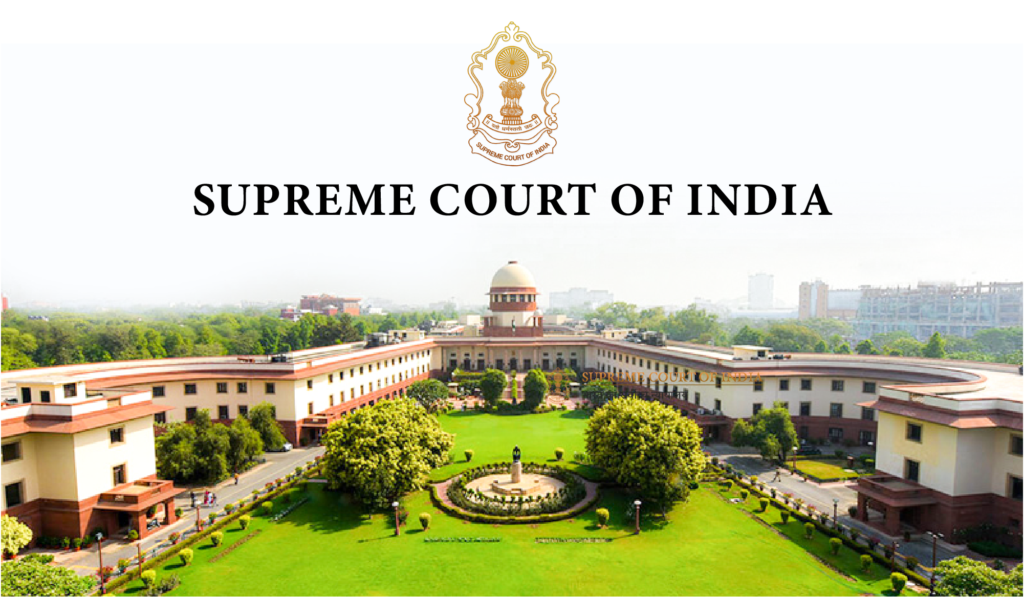
The Supreme Court has held that the power vested in a State Government under Section 17(2) of the Working Journalists and Other Newspaper Employees (Conditions of Service) and Miscellaneous Provisions Act, 1955 to refer a wage dispute to a Labour Court cannot be delegated to any other authority, striking down a 2016 notification of the Government of Maharashtra that had purported to delegate this power to Additional and Deputy Commissioners of Labour.
A Bench of Justice Dipankar Datta and Justice Sheel Nagu delivered the common judgment on August 11, 2026, in a batch of appeals arising out of conflicting decisions of the Aurangabad and Nagpur Benches of the Bombay High Court, involving employees of Dainik Bhaskar Group (D.B. Corp. Ltd.) and All India Reporter Private Ltd.
Background of the Case
The dispute traces back to a notification dated May 11, 2016, issued by the Industries, Energy and Labour Department, Government of Maharashtra, purportedly in exercise of power under Section 17(2) of the Working Journalists Act. This notification delegated the State Government’s power to refer wage disputes to Labour Courts to Additional Commissioners of Labour and Deputy Commissioners of Labour within their respective jurisdictions.
Acting under this delegated authority, references were made to various Labour Courts across Maharashtra, including the Labour Court, Aurangabad, which culminated in an award dated January 4, 2019, in favour of employees of Dainik Bhaskar. The employer challenged this award before a Single Judge of the Bombay High Court, Aurangabad Bench, who, by judgment dated December 22, 2022, set it aside — holding himself bound by an earlier Division Bench ruling of the Nagpur Bench dated November 17, 2022, which had upheld a preliminary objection raised by All India Reporter Private Ltd. and quashed a reference made by the Additional Commissioner of Labour, Nagpur to the Labour Court.
Aggrieved employees — Sudhir and others — and the Brihanmumbai Union of Journalists challenged both the Aurangabad and Nagpur judgments before the Supreme Court, along with a connected appeal filed by the All India Reporter Karamchari Sangh. Since all appeals raised a common question of law regarding the scope of Section 17(2), the Court decided them together.
What the Court Decided
The central question before the Court was whether Section 17(2) of the Working Journalists Act permitted the State Government to delegate its power to refer a dispute over amounts due to a newspaper employee to a Labour Court.
The Bench undertook a close textual comparison of Section 17(1), which expressly empowers the State Government to specify an authority to satisfy itself regarding amounts due and issue recovery certificates, against Section 17(2), which conspicuously contains no such express power of delegation for referring to the Labour Court. Applying the maxim expressio unius est exclusio alterius (the express mention of one thing excludes another), the Court held that the legislature’s silence on delegation in sub-section (2), contrasted with its express provision for delegation in sub-section (1), reflected a deliberate legislative choice not to permit delegation of the referral function.
The Court distinguished its earlier decision in Samarjit Ghosh v. Bennett Coleman & Co. (1987), clarifying that when that judgment described Section 17 as constituting a “single scheme,” it merely meant that the section laid down sequential steps for recovery of dues — not that the power of delegation available under sub-section (1) could be read into sub-section (2). The Court also drew on established administrative law principles from Pradyot Kumar Bose v. Chief Justice of Calcutta High Court and Sahni Silk Mills (P) Ltd. v. Employees State Insurance Corporation, reaffirming that while administrative authorities may routinely obtain assistance and materials through subordinate officials, the ultimate statutory responsibility for exercising a conferred power cannot be sub-delegated unless the law expressly or by necessary implication permits it.
Rejecting arguments that the power under Section 17(2) was akin to the “administrative” referral power of the appropriate Government under Section 10(1) of the Industrial Disputes Act, 1947 and therefore capable of implied delegation, the Court held that Section 17(2), on its plain and unambiguous language, vests the referral power in the State Government alone and in no other authority. The Court accordingly held the Government of Maharashtra’s 2016 notification to be beyond the scope of Section 17(2) insofar as it delegated the referral power, and affirmed the judgments of the Bombay High Court (Aurangabad and Nagpur Benches) as well as a similar view taken by the Punjab and Haryana High Court in Jagran Parkashan Limited v. State of Punjab, while disapproving of a contrary view taken by the Allahabad High Court in the Amar Ujala case.
Despite this finding, the Court did not simply dismiss the appeals and leave the parties remediless. Recognising the lapse of time, the fact that the Working Journalists Act itself now stands repealed with effect from November 21, 2025 by the Occupational Safety, Health and Working Conditions Code, 2020, and that no fresh references under the old Section 17(2) could arise going forward, the Bench invoked Article 142 of the Constitution to mould relief. It directed that the Government of Maharashtra independently revisit every reference earlier made through the specified authorities, record fresh satisfaction on whether a genuine dispute existed warranting reference, and either affirm the reference (allowing proceedings to continue from the stage already reached) or communicate that no valid reference existed (leaving the employee free to pursue other recovery remedies, with limitation running afresh from that communication). Proceedings before Labour Courts and the High Court were directed to remain in abeyance during this exercise, to be completed within six months.
Law Applied
- Section 17 of the Working Journalists and Other Newspaper Employees (Conditions of Service) and Miscellaneous Provisions Act, 1955 — specifically sub-sections (1), (2) and (3), dealing respectively with recovery of dues, reference of disputed questions to a Labour Court, and post-decision recovery
- Industrial Disputes Act, 1947, particularly Section 10(1), invoked comparatively though ultimately distinguished
- Occupational Safety, Health and Working Conditions Code, 2020, which repealed the Working Journalists Act with effect from November 21, 2025, and the Industrial Relations Code, 2020, which repealed the Industrial Disputes Act, 1947 from the same date
- Article 142 of the Constitution of India was invoked by the Court to mould equitable relief and prevent multiplicity of proceedings.
- Precedents applied include Samarjit Ghosh v. Bennett Coleman & Co. (1987) 3 SCC 507, Pradyot Kumar Bose v. Chief Justice of Calcutta High Court (1955) 2 SCC 791, Sahni Silk Mills (P) Ltd. v. ESIC (1994) 5 SCC 346, Marathwada University v. Seshrao Balwant Rao Chavan (1989) 3 SCC 132, and All India Reporter Karamchari Sangh v. All India Reporter Private Limited, AIR 1988 SC 1325, among others.
Practical Impact
The judgment settles, authoritatively, a question that had produced conflicting High Court decisions across the country — including divergent views from the Bombay, Allahabad, and Punjab & Haryana High Courts — on whether State Governments can outsource their referral function under Section 17(2) of the Working Journalists Act. Going forward, the ruling confirms that such delegation was never legally valid, a finding of considerable significance for the many labour references made pursuant to similar state notifications over the years.
At the same time, by resorting to Article 142, the Court has avoided the harsher consequence of wholesale invalidation of years of pending labour litigation. Employees whose wage claims were referred to Labour Courts through delegated authorities are not left without remedy; instead, the Government of Maharashtra must now revisit each reference on its own merits within a fixed six-month timeline. Where the Government certifies that a genuine dispute existed, proceedings will continue from the stage already reached, without employees having to start afresh or lead evidence already led. Where it does not, employees retain the right to pursue recovery through other means, with a fresh limitation period.
For newspaper establishments, including major media houses, the ruling means that awards and references made through delegated authorities remain under a cloud until the State Government’s confirmatory exercise is complete. Still, the judgment also protects settled matters — clarifying that employers cannot use this ruling to reopen proceedings already concluded where the validity of the reference was never challenged before a higher court. With the Working Journalists Act now repealed and subsumed within the Occupational Safety, Health and Working Conditions Code, 2020, this judgment will chiefly govern the wind-down of pending legacy disputes rather than shape future references, but its reasoning on the limits of administrative delegation retains broader significance for administrative law.
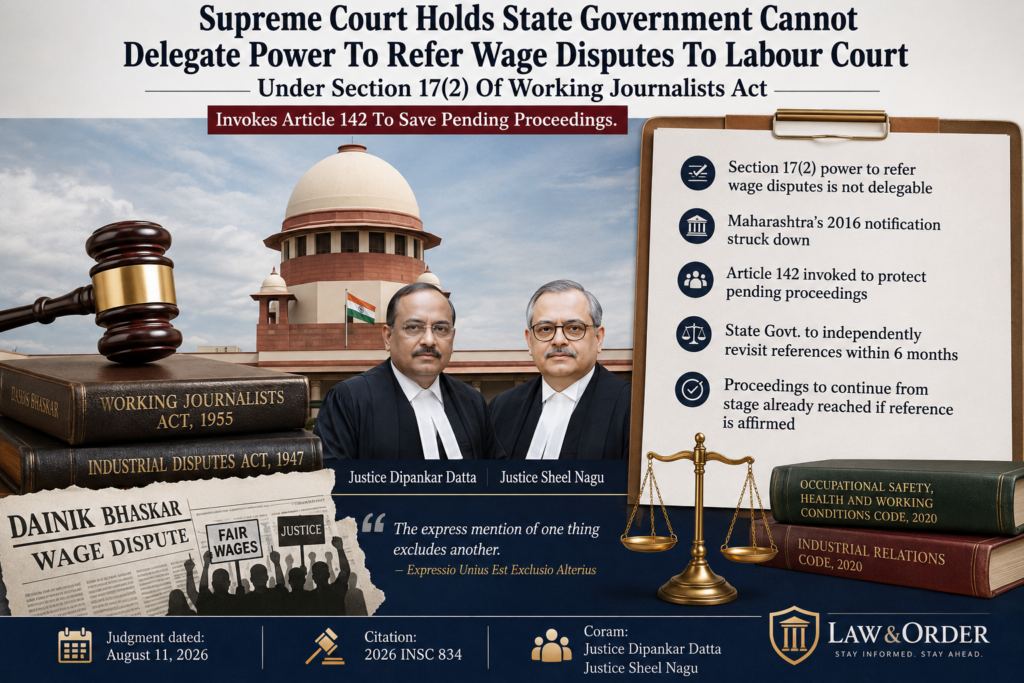
Coram: Justice Dipankar Datta and Justice Sheel Nagu
Judgment dated: August 11, 2026
Citation: 2026 INSC 834 create image on behalf this article