In a 2:1 verdict, the Supreme Court kept the three-year Bar practice eligibility rule for Civil Judge (Junior Division) recruitment intact but softened its rigour through a five-year transitional scheme of deemed practice, academy training and clerkships.
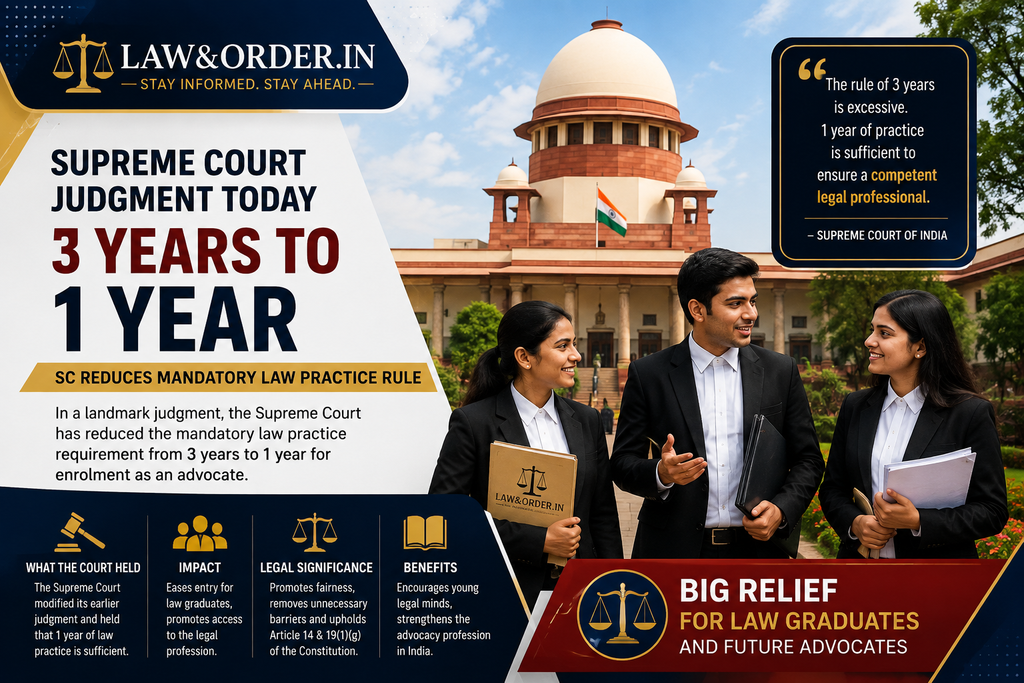
The Supreme Court has declined to do away with the requirement of three years’ practice at the Bar for candidates seeking to enter judicial service as Civil Judge (Junior Division), but has substantially reworked how that requirement will operate. In a judgment dated August 21, 2026, a Bench of Chief Justice of India Surya Kant and Justice Augustine George Masih held that fresh law graduates will not be kept out of the recruitment process altogether. Instead, they will be deemed to have completed one year of practice, and will be required to make up the remaining two years through a year of structured training at a State Judicial Academy followed by a year of supervised law clerkship, all after they clear the recruitment examination. Justice K. Vinod Chandran, the third judge on the Bench, disagreed with this approach in a separate opinion and would have simply dismissed the review petitions, leaving the three-year practice requirement as originally restored.
The ruling arises out of a batch of matters, including Writ Petition (Civil) No. 1110/2025 filed by Bhumika Trust, three Review Petitions, and two interlocutory applications, all connected to the Court’s earlier judgment of May 20, 2025 in All India Judges Association v. Union of India (referred to in the judgment as the “Judgment under Review”), which had restored a minimum of three years’ practice at the Bar as an eligibility condition for appearing in the Civil Judge (Junior Division) examination.
Case Background
The requirement of a minimum practice period for entry-level judicial recruitment has a long and shifting history before the Supreme Court. It was first introduced in the Second All India Judges’ Association case decided on August 24, 1993, which directed all States to prescribe three years of practice as an essential qualification, reasoning that if the Constitution itself required seven, ten, and ten years of practice respectively for appointment as District Judges, High Court Judges, and Supreme Court Judges under Articles 233(2), 217(2)(b), and 124(3)(b), similar experience could not be dispensed with at the entry level of adjudication.
That position was reversed in 2002. Acting on the recommendations of the Justice K.J. Shetty-headed First National Judicial Pay Commission, which found that the evolution of legal education, particularly the introduction of the three-year and five-year integrated LL.B. courses, had reduced the need for prior practice, the Court in the Third AIJA case did away with the three-year requirement altogether. This position held the field for over two decades, during which fresh law graduates with no Bar experience were eligible to compete for judicial posts.
In 2023, the Supreme Court was again called upon to examine this question as part of a wider set of issues concerning judicial recruitment. After calling for responses from every High Court and State Government, and relying on affidavits describing recruits with no prior exposure to court proceedings as being unfamiliar with court decorum and unable to handle urgent matters, the Court concluded that the twenty-year experiment with fresh graduates “has not been a successful experience.” By its judgment of May 20, 2025, it restored the three-year practice requirement, along with connected directions on certification of practice and one year of post-selection training.
It is this restoration that has now been substantially revisited. Writ Petition (Civil) No. 1110/2025 was filed by Bhumika Trust, an organisation representing several hundred persons with disabilities, seeking clarification on how the restored requirement interacts with the Court’s judgment in In Re: Recruitment of Visually Impaired in Judicial Services, and seeking exemption from the three-year condition for the candidates it represents. Three Review Petitions sought recall of the directions restoring the requirement, while two interlocutory applications sought that time spent pursuing higher legal education be counted towards the three years.
Legal Issue Before The Court
The central question was not whether some prior exposure to the working of courts is desirable for a person about to assume judicial office, an issue the Bench declined to reopen. The more precise question was whether that exposure necessarily had to take the form of three years of conventional Bar practice, and whether the manner in which the requirement had been suddenly restored, as a precondition even for sitting the examination, was fair to a generation of law graduates who had planned their careers around the two-decade-old regime that allowed fresh graduates to compete.
Arguments of the Parties
Senior Advocates Ms. Pinky Anand, Ms. Vibha Makhija and Mr. Colin Gonsalves, appearing for the petitioners and review petitioners, argued that the restored requirement did not adequately consider whether the same objectives could be achieved through a shorter period of practical exposure combined with enhanced institutional training, and that the quality of Bar practice varies too widely from candidate to candidate to reliably build judicial temperament. They submitted that the requirement would disproportionately burden women and candidates from marginalised and economically weaker backgrounds, who often receive little or no remuneration during their initial years at the Bar, and pointed out that under the restored regime a candidate would typically reach the post of District Judge only after the age of forty-one. It was also argued that the sudden restoration had caused retrospective hardship to candidates who had prepared for years on the legitimate expectation of appearing immediately after graduation.
The Court also received detailed suggestions from High Courts, Law Universities and National Law Schools, pursuant to its order dated January 15, 2026. A larger number of High Courts, including Calcutta, Delhi, Kerala, Madhya Pradesh and Telangana among others, favoured a uniform condition without any category-based exemption. Four High Courts, Meghalaya, Uttarakhand, Sikkim and Tripura, favoured some relaxation, particularly for specially-abled candidates. Several National Law Universities, including NLU Jodhpur, NLU Delhi and NALSAR Hyderabad, proposed a shorter practice period reinforced by structured post-selection training. The learned Amicus Curiae, Mr. Siddharth Bhatnagar, placed four possible approaches before the Court, ranging from retaining the requirement unmodified to a staggered transition phased in over three recruitment cycles.
What The Court Held
The majority held that it was not persuaded to reconsider the fundamental finding of the Judgment under Review that some prior exposure to the functioning of courts is necessary before a person assumes judicial office. It reiterated that a Civil Judge deals with questions of life, liberty, property and reputation from the very first day in office, and that such experience contributes to judicial temperament, patience and an appreciation of the respective roles of the Bench and the Bar.
However, the Court found that the manner of implementing the requirement needed to change. It observed that the quality of practice at the Bar depends considerably on the chamber, the court, the availability of a mentor and the financial circumstances of the candidate, so that mere passage of time at the Bar does not, by itself, guarantee meaningful exposure. It also noted that judicial training infrastructure has evolved substantially since the three-year rule was first conceived, with State Judicial Academies now offering structured, supervised training that can impart many of the same skills a young advocate might otherwise acquire unevenly.
Court’s Key Reasoning
The Bench reasoned that an eligibility requirement should not, through the manner of its implementation, exclude candidates whom the judicial system would otherwise benefit from attracting. It was particularly concerned about the sudden effect of the May 2025 judgment on a generation of law graduates who had planned to sit the examination immediately upon graduation, and about the requirement’s disproportionate impact on candidates without financial support or established networks, without going so far as to carve out separate eligibility regimes for specific categories, a step several High Courts had cautioned against.
The Court drew support from its own earlier direction that experience gained as a Law Clerk to a Judge should count towards the three-year period, holding that this already reflected an acknowledgment that meaningful exposure to court functioning could come from routes other than conventional advocacy. Extending this logic, it held that a structured combination of institutional training and supervised clerkship, undertaken after selection, could serve as the functional equivalent of practice at the Bar, while still preserving the underlying object of ensuring judicial readiness.
Final Directions / Relief
The Court modified the Judgment under Review and laid down a two-track scheme. For recruitment notifications issued after the May 2025 judgment up to March 31, 2027 (the transitional period), all law graduates are eligible to apply notwithstanding the three-year requirement, and are deemed to have completed one year of practice without needing a separate certificate. Selected candidates will be designated “Trainee Judicial Officers” and must undergo one year of intensive training at the concerned State Judicial Academy, paid a fixed emolument equal to half the remuneration of a Judicial Magistrate First Class. This is treated as equivalent to a further year of practice. Thereafter, trainees must complete a further year of structured Law Clerkship, the first six months under a Principal District/Sessions Judge or a Higher Judicial Service member, and the remaining six months under a sitting High Court Judge, also treated as equivalent to a year of practice. Only upon a satisfactory reasoned evaluation report from the supervising High Court Judge will the trainee be appointed to the regular post with full pay and service benefits.
For notifications issued on or after April 1, 2027, candidates must possess at least one year of actual, certified practice to apply, verified through a Certificate of Practice confirming genuine participation in judicial proceedings. Selected candidates will still undergo the same one-year academy training and one-year clerkship, regardless of their prior practice.
The Court directed State Governments, in consultation with the jurisdictional High Courts, to notify the necessary rule amendments within three months, and vacated the interim orders passed during the pendency of these proceedings. It held that the scheme addresses the concerns raised by Bhumika Trust regarding accommodation for persons with disabilities, dismissed the interlocutory applications seeking that higher legal education be counted towards the practice period, and directed that the scheme remain in force for five years, after which its working will be placed before the Court for review.
Justice K. Vinod Chandran, dissenting on this specific relief, held that judicial service could not be equated with other public services such as the IAS or IFS because judicial acts, unlike administrative decisions, are not subject to ordinary supervisory correction short of appeal. He was of the view that a two-year training and clerkship regime, largely without full pay, would be prejudicial to new recruits, strain the exchequer, and leave courts unmanned during the interim, and would also create inequity between recruits with differing amounts of prior practice being treated alike. In his opinion, there was no ground for review of the well-considered May 2025 judgment, and the review petitions ought to have been dismissed outright.
Legal Significance
The judgment is significant for reaffirming, for now, that some prior exposure to the working of courts remains a legitimate condition for entry into judicial service, while addressing the practical hardship caused by the abrupt restoration of the three-year Bar practice rule in May 2025. By allowing structured institutional training and supervised clerkship to count towards the practice requirement, the Court has opened an alternative pathway into judicial service that does not solely depend on conventional years spent at the Bar. The five-year sunset clause built into the scheme indicates that the Court intends the arrangement to be assessed on the basis of actual outcomes, including the quality of recruitment and the performance of officers trained under it, rather than treated as a permanent settlement of the question.